
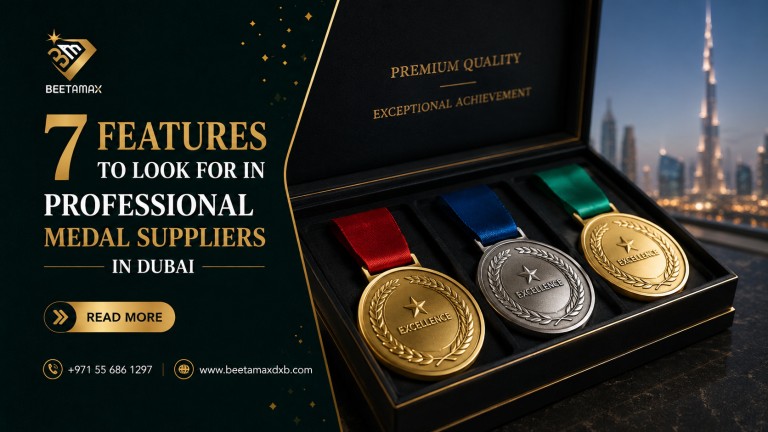
7 Features to Look for in Professional Medal Suppliers in Dubai
Dubai’s events calendar never really slows down. Marathons, school sports days, corporate award nights, and international tournaments run through the city almost every week. Behind every finish line and every award ceremony sits a medal. That medal needs to look and feel premium, arrive on time, and represent the brand or organization handing it out. So, choosing the right manufacturer for that medal is not a small decision. The wrong supplier can mean delayed shipments, inconsistent plating, or a design that simply doesn’t match the brief. Below are seven features worth checking before you commit to a medal supplier in Dubai.
1. In-House Manufacturing Capability
 A genuine medal manufacturer owns its production process. This includes die-casting, die-striking, CNC engraving, and electroplating, rather than outsourcing to a third party and reselling. As a result, in-house production gives a supplier direct control over tooling accuracy, plating consistency, and lead times. It usually also means lower costs on bulk orders, since there is no middleman markup. So, when you evaluate a supplier, ask whether they manufacture on-site in Dubai. Alternatively, find out if the order routes through an overseas factory with less predictable timelines.
2. Material Quality and Finishing Options
Manufacturers typically strike or cast medals from zinc alloy or brass. Then, they finish them in gold, silver, bronze, antique, or nickel plating. A professional supplier will stay transparent about base metal thickness, plating type, and whether finishes are electroplated (more durable) or simply painted. Additionally, look for suppliers who offer enamel colour-fill, soft or hard enamel, epoxy doming, and hybrid designs. These combine metal with acrylic or crystal elements. In the end, these details separate a mass-produced medal from a genuinely premium one.
3. Customization and Design Flexibility
 Every event has its own identity. So, a good medal supplier should be able to translate a logo, mascot, or theme into a 2D or 3D medal design without losing detail. This includes custom shapes and cut-outs, spinner medals, multi-layer designs, colour-matched ribbons and neck tapes, and personalized engraving for individual winners. Before full production, ask to see 3D renders or a physical sample. A supplier confident in their design process will offer this as standard, not as an extra step you have to request.
4. Certifications, Licensing, and Industry Reputation
Manufacturers often produce medals for corporate clients, government bodies, and international sporting federations. Because of this, it matters that the supplier runs a properly licensed manufacturing business in the UAE, not an informal trading setup. So, check for a registered trade license, a real factory address, and a visible track record. This might include completed projects, client testimonials, or industry recognitions. Generally, a supplier that can point to established relationships with sports federations, event organizers, or corporate brands makes a safer long-term partner.
5. Turnaround Time and Bulk Order Capacity
 Marathons and large-scale corporate events can require anywhere from a few hundred to tens of thousands of medals. Often, these come with a fixed event date that cannot move. Therefore, a professional supplier should state a realistic production timeline upfront, typically 7 to 15 working days for standard orders. They should also confirm their capacity to scale for bulk quantities. Importantly, this means keeping weight, colour, and plating consistent across the entire batch.
6. Transparent, Itemized Pricing
Reliable suppliers break down pricing by mould/tooling cost, per-unit medal cost, plating, ribbon, and packaging. They avoid quoting a single vague figure. This transparency lets you compare quotes fairly across suppliers. It also helps you avoid unexpected charges for design revisions, rush production, or custom packaging later in the process. However, stay cautious of quotes that seem unusually low with no breakdown. Often, they signal thinner metal, weaker plating, or hidden costs down the line.
7. Responsive Customer Support and After-Sales Service
From the first design brief to final delivery, communication quality often gives the clearest signal. It shows how a supplier will handle problems if they arise. So, look for a team that assigns a single point of contact. They should also share proofs and progress updates proactively. In addition, they should stand behind the order with reprints or corrections if there’s a defect. Furthermore, suppliers who offer packaging, presentation boxes, and reliable delivery across the UAE (and internationally) add real value beyond just the medal itself.
Final Thoughts
A medal is a small object that carries a lot of weight. Often, it becomes the physical memory an athlete, employee, or student keeps from the day they were recognized. So, choosing a supplier with in-house manufacturing, transparent pricing, strong design capability, and dependable delivery timelines removes most of the risk from the process. In turn, this ensures the finished piece matches the occasion it’s meant to celebrate.
So, if you’re planning an upcoming event and need custom medals produced in Dubai, reach out to us. Beetamax’s in-house team handles everything, from concept and 3D design through casting, plating, and delivery. Feel free to explore the full range on our Medal Suppliers page, or contact our team for a free, itemized quote.
FAQ Section
1. What is the average cost of custom medals in Dubai?
Pricing depends on material (metal alloy vs. zinc die-cast), plating (gold, silver, bronze, antique), size, ribbon type, and order quantity. Generally, bulk orders of 100+ pieces bring the per-unit cost down significantly. So, request an itemized quote so you can compare suppliers on a like-for-like basis.
2. How long does it take to manufacture custom medals in Dubai?
Standard production for die-struck or die-cast medals usually takes 7 to 15 working days once artwork is approved. However, this varies by design complexity, plating type, and order size. Typically, suppliers with in-house tooling and casting can turn around rush orders faster than those outsourcing production.
3. Can medal suppliers in Dubai handle bulk orders for large sporting events or marathons?
Yes, they can. Established manufacturers with dedicated casting, electroplating, and finishing lines can produce several thousand medals for marathons, school sports days, and corporate tournaments. Meanwhile, they keep every piece consistent in weight, colour, and finish.
4. What materials are commonly used for medals in Dubai?
Zinc alloy and brass make up the most common base metals. Manufacturers finish these with gold, silver, bronze, antique, or nickel plating. Additionally, suppliers offer enamel colour-fill, epoxy coating, and combinations with acrylic or crystal for a premium, layered look.
5. Do professional medal suppliers offer design and ribbon customization?
Yes, reputable suppliers provide full customization. This includes 2D or 3D logo engraving, custom shapes, colour-matched ribbons, neck tapes, and branded packaging or medal boxes. As a result, the final piece reflects your event or organization’s identity.
6. How do I verify that a medal supplier in Dubai is reliable?
Check for a physical manufacturing facility, not just a trading office. Also look for a portfolio of completed projects, business licensing, and clear communication on lead times. Finally, check reviews or testimonials from past corporate or sports-event clients.
