
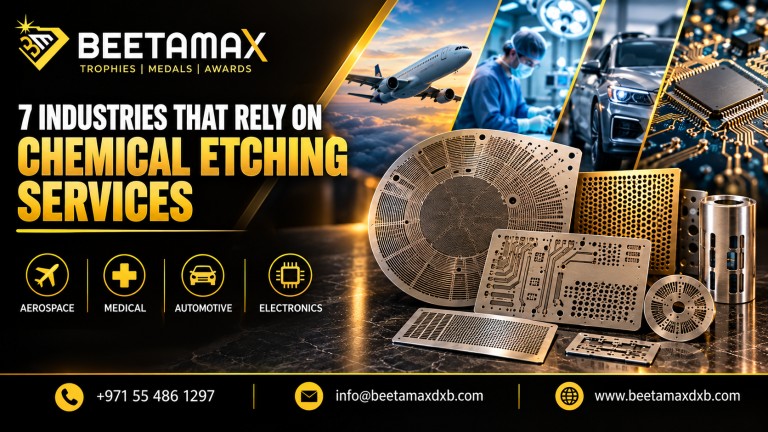
7 Industries That Rely on Chemical Etching Services
Look closely at the nameplate in a lift, the fine mesh inside an electric shaver or the logo on an award, and there is a good chance chemical etching made it. The process uses a protective mask and a controlled chemical solution to dissolve metal exactly where it is needed, without heat or mechanical stress. That precision is why chemical etching services support so many industries, from aerospace to hospitality.
Here are seven sectors that depend on etched metal parts and markings, and why the process suits each one.
How Chemical Etching Works in Brief
The design is printed onto a light sensitive film and transferred to clean metal. The exposed areas are then dissolved by an etchant, while the protected areas stay intact. The industrial version of the process, often called photochemical machining, produces thin, burr free parts with a level of detail that stamping or cutting struggles to match on delicate sheets.
1. Electronics
Electronics manufacturers etch shielding cans, contact springs, lead frames and fine meshes. Because there is no hard tooling for each new design, engineers can move from prototype to production quickly and change designs without paying for new dies.
2. Aerospace
Aircraft makers have used chemical milling for decades to remove weight from large aluminium skins and structural panels. Etching takes material away evenly across complex shapes, which reduces weight while keeping strength where it matters.
3. Medical Devices
Surgical instrument parts, implant components and filter screens need clean edges with no burrs or stress points. Etching delivers that finish on stainless steel and titanium, which suits devices that must be sterilised again and again.
4. Automotive
Car makers use etched parts for fuel cell plates, sensors, gaskets, speaker grilles and decorative trim. Badges and interior plaques also rely on etching for crisp detail that survives heat, vibration and regular cleaning.
5. Architecture and Signage
Lobbies, lifts and building entrances use etched brass and stainless steel for nameplates, directories and wayfinding signs. The recessed design can be colour filled for contrast, and it resists weathering, which matters in Dubai’s heat and humidity.
6. Awards and Recognition
The awards industry uses etching for detailed logos, text and textures on plaques, medals and trophies. Fine lines that would be hard to engrave come out sharp and consistent across a full batch. Many Metal Trophies and plaques combine etched artwork with polished or plated finishes, and established medal suppliers in Dubai use the process to keep detail identical across hundreds of pieces.
7. Corporate Branding and Gifts
Businesses use etched metal for business cards, bookmarks, keychains, desk plaques and office nameplates. A logo etched into brass or steel feels more permanent than print, which makes it a natural fit for long service gifts and executive desk pieces.
Why These Industries Choose Etching
Across all seven sectors, the reasons are much the same:
- No heat or mechanical stress, so thin metals stay flat and true.
- Burr free edges, with no extra finishing needed in most cases.
- Fine detail repeated accurately across large runs.
- Low setup cost for design changes compared with hard tooling.
- Wide metal choice, including stainless steel, brass, copper, aluminium and nickel alloys.
These are the same qualities our chemical etching services bring to nameplates, plaques, signage and awards for clients across the UAE.
Etching Compared With Other Marking Methods
Etching is not the only way to mark or shape metal. Laser engraving works well for one off pieces and serial numbers, while stamping suits very high volumes of simple shapes once the tooling is paid for. Etching sits in between. It shines when a design has fine detail, when the metal is thin and when a batch needs every piece to match exactly.
How to Brief an Etching Supplier
A clear brief saves time and avoids costly reworks. Before you request a quote, prepare:
- Vector artwork with all text converted to outlines.
- The metal type, thickness and finished size.
- The quantity, plus any future repeat orders.
- Colour fill, plating or polishing requirements.
- Where the piece will be used, indoors or outdoors.
With these details, a supplier can recommend the right etch depth and finish for the job.
Start Your Etching Project
Whether you need a single plaque or a full run of branded nameplates, the right partner makes the difference between a crisp result and a blurry one. As experienced trophy manufacturers in Dubai, Beetamax handles artwork preparation, etching, colour filling and finishing in house at our Al Qusais facility. Explore our chemical etching services and send us your artwork, metal choice and quantities for a quote.
Contact Beetamax today to discuss your chemical etching project.
📞 +971 55 486 1297
✉️ [email protected]
Frequently Asked Questions
1. What is chemical etching used for?
Chemical etching is used to make precise metal parts and markings. Common uses include electronic shielding and meshes, aerospace panels, medical device components, automotive badges, building signage, award plaques and branded corporate gifts. It suits any job that needs fine detail, burr free edges and consistent results on thin metal sheets.
2. Which metals can be chemically etched?
Most common metals can be chemically etched, including stainless steel, brass, copper, aluminium, nickel alloys and titanium. At Beetamax, we regularly etch stainless steel, brass, copper, aluminium and nickel for plaques, nameplates, awards and branded items. The right metal depends on the look, durability and environment the finished piece needs to suit.
3. Is chemical etching better than laser cutting?
It depends on the job. Chemical etching is better for thin sheets, very fine detail and large batches, because it adds no heat and leaves no burrs. Laser cutting suits thicker metals and one off pieces with variable text. Many projects combine both methods to balance detail, speed and cost.
4. How durable are chemically etched markings?
Etched markings are recessed into the metal itself, so they do not peel, fade or rub off like printed graphics. When etched to a proper depth on stainless steel or brass, they withstand outdoor weather, regular cleaning and handling for many years, which is why they are popular for signage, nameplates and awards.
5. What artwork do I need for a chemical etching project?
Supply your design as a vector file, such as AI, EPS, PDF or SVG, with all text converted to outlines. Note the metal, size, thickness and quantity, plus any colour fill areas. Clean vector artwork lets the supplier create an accurate photo tool, which keeps fine lines and small text sharp after etching.
