
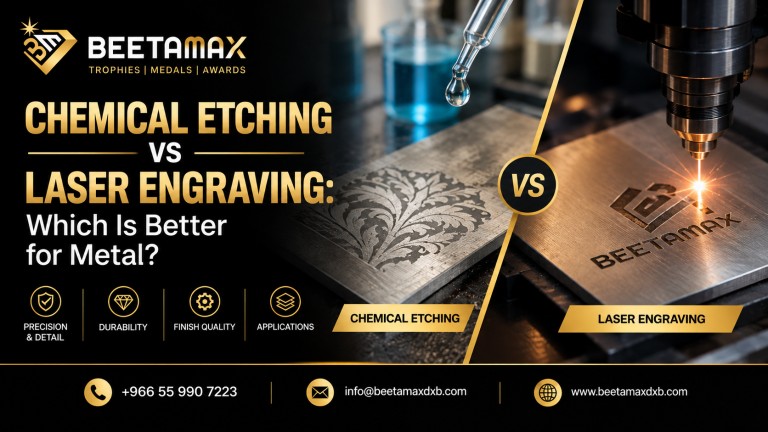
Chemical Etching vs Laser Engraving: Which Is Better for Metal?
Updated September 2026 · 10 min read · beetamaxdxb.com
A brass plaque, a stainless steel nameplate and a metal trophy can all carry the same logo, yet look and wear very differently depending on how that logo got there. The choice usually comes down to chemical etching vs laser engraving. Both put permanent marks on metal. They get there in completely different ways, and that difference shows up in depth, detail, durability and price.
At Beetamax in Dubai, we use both methods every week on plaques, nameplates, trophies and corporate gifts. This guide explains how each one works, where each wins, and how to pick the right one for your project.
How Chemical Etching Works
Chemical etching uses a controlled chemical reaction to dissolve metal where you want the design, and leaves it untouched everywhere else. In industry the same principle is called photochemical machining, and it is valued for high dimensional accuracy with almost no residual stress in the metal, as a 2024 study in Frontiers in Mechanical Engineering notes.
For decorative and branding work, the process runs in four stages:
- Clean and coat. The metal is degreased and covered with a protective resist.
- Apply the design. The artwork is transferred so that only the areas to be etched are exposed.
- Etch. An etchant removes the exposed metal to a controlled depth, while the protected areas stay intact.
- Strip and finish. The resist comes off, revealing a crisp, recessed design that can be colour filled, polished or left natural.
Because the chemistry works on the whole surface at once, a panel with one logo or fifty nameplates takes roughly the same etch time. You can see finished examples on our chemical etching services page.
How Laser Engraving Works
Laser engraving uses a focused beam to heat and vaporise a thin layer of metal, tracing the design line by line. Fiber lasers are the standard tool for metals.
Not every “laser mark” is a true engraving. As Keyence explains, engraving removes material to create visible depth, while annealing and other colour-marking methods change the surface appearance with little or no material removed. That distinction matters for how long the mark lasts.
Laser work is digital from file to finished piece. There are no masks or chemicals, so changing a name or number between pieces costs nothing extra.
Chemical Etching vs Laser Engraving: Side-by-Side Comparison
| Factor | Chemical etching | Laser engraving |
|---|---|---|
| How it marks | Dissolves metal through a masked chemical reaction | Vaporises metal with a focused beam |
| Depth | Controlled, even depth across large areas; deep etching possible | Usually shallow; deeper cuts need many passes and more time |
| Detail | Very fine lines and sharp edges, uniform across the whole design | Excellent for fine text, logos and photos on small areas |
| Large solid areas | Efficient; the whole area etches at once | Slow; every square millimetre must be scanned |
| Heat effect | None; no heat-affected zone or warping | Localised heat can discolour or distort thin metal |
| Colour fill | Recessed areas hold paint or enamel well | Possible on deep engravings; limited on shallow marks |
| Personalisation | Each change needs new artwork and a new mask | Each piece can differ at no extra setup cost |
| Setup | Artwork and masking required | Minimal; runs from a digital file |
| Best for | Batches, plaques, signage, nameplates, deep or filled designs | One-offs, names, serial numbers, quick turnarounds |
Where Chemical Etching Wins
Durability outdoors and in harsh conditions
An etched design is part of the metal itself. With enough depth, it survives weathering, cleaning and handling that would wear away a shallow surface mark. That makes etching a strong choice for building signage, outdoor plaques and equipment nameplates in the UAE’s heat, humidity and dust.
Large or solid-fill designs
A plaque with a big background texture, a filled logo or a full block of text etches in the same time as a simple outline. A laser would need to scan every part of that area, which adds hours on larger pieces.
Colour-filled branding
Etched recesses give paint and enamel a clean edge to sit behind. This is how many corporate nameplates and brass plaques get their crisp two-tone look. Etching works well on stainless steel, brass, copper, aluminium and nickel.
Batch consistency
Once the artwork is set, every piece in a batch comes out identical. For fifty staff nameplates or a run of branded plaques, that uniformity is hard to beat.
Where Laser Engraving Wins
Personalisation and one-offs
If every trophy carries a different winner’s name, laser engraving is the practical choice. Our metal trophies and custom medals are typically personalised this way.
Speed on small marks
With no masks to prepare, a single engraved plate can be ready very quickly. That suits last-minute event awards.
Serial numbers and variable data
Barcodes, QR codes and sequential numbers change on every piece. A laser handles them without new setup.
Non-metal materials
Lasers also mark crystal, acrylic and wood. On mixed-material awards such as blended trophies, one process can finish every part.
Cost: What Changes the Price?
Neither method is always cheaper. Price depends on the job:
- Quantity. Etching has a setup cost for artwork and masking, which spreads well over batches. Laser has almost no setup, so it is often cheaper for one or two pieces.
- Area and depth. Large, deep or solid designs favour etching. Small, shallow marks favour laser.
- Personalisation. Unique text on every piece favours laser.
- Finishing. Colour fill, polishing and plating add cost to either method.
Which Should You Choose? A Quick Guide
| Your project | Better choice |
|---|---|
| Outdoor building plaque or signage | Chemical etching |
| 50+ identical branded nameplates | Chemical etching |
| Brass plaque with colour-filled logo | Chemical etching |
| Trophies with individual winner names | Laser engraving |
| Serial numbers, barcodes or QR codes | Laser engraving |
| Single urgent award | Laser engraving |
| Etched logo plus personal names | Both: etch the design, laser the names |
Combining the two is common. A corporate award can carry a deep-etched, colour-filled logo and a laser-engraved recipient name. You get lasting branding and flexible personalisation in one piece.
Applications We Handle in Dubai
- Corporate nameplates and door signs
- Brass and stainless steel plaques for buildings and openings
- Metal trophies, shields and awards
- Branded corporate gifts such as pens, card holders and desk items
- Equipment and industrial identification plates
See recent work in our projects.
Talk to Beetamax About Your Metal Marking Project
Beetamax Crystal & Metal Premium has made custom awards, plaques and branded metal pieces in Dubai since 2018, for clients across the UAE and Saudi Arabia. Explore our chemical etching services in Dubai, browse our services, then contact our team with your artwork, metal and quantity for a clear recommendation and quote.
Frequently Asked Questions
1. What is the difference between chemical etching and laser engraving?
Chemical etching dissolves metal through a masked chemical reaction, marking the whole design at once. Laser engraving vaporises metal with a focused beam, tracing the design line by line.
2. Which is more durable, etching or engraving?
Both are permanent when done to a proper depth. Deep chemical etching usually holds up better outdoors and under heavy cleaning, while shallow laser marks can fade with abrasion.
3. Is chemical etching cheaper than laser engraving?
For batches and large designs, etching is often more economical. For one-off pieces or unique text on every item, laser engraving usually costs less because there is no setup.
4. What metals can be chemically etched?
We etch stainless steel, brass, copper, aluminium and nickel, which covers most plaques, nameplates and awards.
5. Is chemical etching suitable for outdoor signs?
Yes. An etched design is recessed into the metal, so it resists weathering and corrosion well, especially on stainless steel and brass.
6. Which method is better for serial numbers and one-off pieces?
Laser engraving. It runs from a digital file, so each piece can carry different text or numbers without new setup.
7. Can etched designs be colour filled?
Yes. The recessed areas hold paint or enamel cleanly, which is how many nameplates and plaques get a sharp two-tone finish.
