
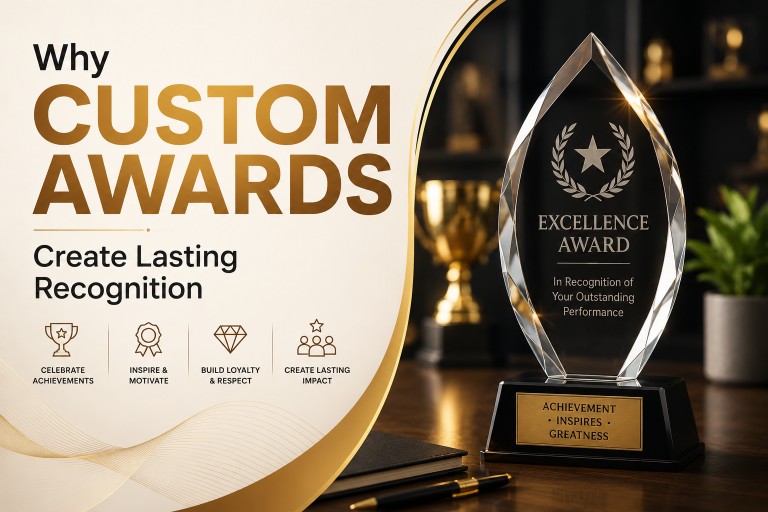
Why Custom Awards Create Lasting Recognition
Published June 2026 · Awards & Recognition Insights · 10 min read
| Think about the last generic award you received a standard certificate, a mass-produced trophy, a digital badge. Can you remember exactly what it said? Most people cannot. Now think about a moment when someone recognised your specific contribution with something clearly designed around you. That memory stays. This is not accidental. It is neuroscience, psychology, and good organisational design working together. |
The Numbers Behind Recognition
45%less likely to quitwhen regularly recognised (Gallup) |
5–7xROI return for every$1 spent on recognition |
31%lower voluntary turnoverwith formal recognition programs |
78%of HR leaders say recognitionboosts retention (HBR) |
21%higher productivity inrecognition-driven cultures |
65%of businesses saw higher performanceafter recognising employees |
The Problem With Generic Awards
Every year, organisations spend significant sums on recognition programs that fail to create the impact they intend. The culprit is rarely the budget. It is the approach. Generic awards the kind produced in bulk, presented identically to every recipient, and devoid of specific meaning function more as administrative checkboxes than as genuine acts of acknowledgement.
When an employee receives a mass-produced plaque with only their name swapped out, the implicit message is not one of recognition.
| The Specificity Gap
Broad praise fades quickly. Research from Bennett Awards consistently shows that recognition tied to specific contributions drives higher engagement, stronger goal alignment, and improved retention — while generic recognition produces minimal measurable difference in behaviour. |
This distinction plays out in measurable ways. Employees who receive recognition they describe as ‘personal and specific’ report significantly higher job satisfaction scores than those who receive ‘general acknowledgement’. The format of the recognition whether physical, digital, verbal, or written matters less than whether it communicates specificity and genuine intent.
The Neuroscience of Being Recognised
Understanding why custom awards work requires a brief visit to the brain. When a person receives meaningful recognition, the brain releases dopamine the same neurotransmitter associated with pleasure, motivation, and learning. This is not metaphorical. Recognition activates the brain’s reward circuitry in measurable, physiological ways, reinforcing the behaviours that led to the recognition and creating a neurological incentive to repeat them.
But dopamine alone does not explain the full picture. The lasting impact of a well-designed custom award also involves identity. When recognition feels genuinely personalised. The award does not merely say ‘you did well.’ It says ‘this is who you are, and we see it.’
| The Identity Anchor Effect
Behavioural psychology studies indicate that tangible, personalised awards produce stronger emotional responses than digital or verbal recognition alone. A custom award placed on a desk or displayed at home functions as a daily reminder of capability and belonging —reinforcing confidence and professional identity without any further action required. |
This is why recipients of custom awards are more likely to display them prominently. The award has become part of how they represent themselves to colleagues, family, and visitors. That visibility creates a second layer of recognition social validation every time someone asks about it.
Custom vs Generic: A Direct Comparison
The performance gap between custom and generic awards is consistent across industries, organisation sizes, and recognition contexts. The table below summarises the key differentiators.
| Criteria | Custom Award | Generic Award |
| Personalization | Name, role & achievement specific | One-size-fits-all |
| Emotional Impact | High — feels designed for the recipient | Low — interchangeable |
| Memory Retention | Recalled years later | Forgotten quickly |
| Display Behaviour | Prominently displayed at desk/home | Often stored away |
| Culture Signal | Communicates deep organisational values | Tick-box gesture |
| Motivation Duration | Long-lasting reinforcement | Short-term boost only |
| Retention Influence | Directly linked to lower turnover | Minimal measurable impact |
The most significant column in the table above is not emotional impact or display behaviour — it is retention influence. Replacing an employee costs between 50% and 200% of their annual salary. Recognition programs that tangibly reduce voluntary turnover pay for themselves within months, not years.
The Five Elements of a Lasting Custom Award
Not every custom award creates lasting recognition. Personalisation alone is not sufficient. The following five elements, when combined, distinguish awards that become career milestones from those that are appreciated once and then stored in a drawer.
1. Specificity of Achievement
The award should identify the specific achievement rather than a broad category. Greater detail helps recipients feel genuinely recognised and appreciated.
2. Personalisation of the Recipient
Name and role are the baseline. The strongest awards reference something about how this specific person achieved the outcome — their approach, their tenacity, or their influence on the team. A single line of bespoke copy on an award can transform it from a product into a memory.
3. Quality of Materials and Craft
The perceived value of an award communicates how much the organisation values the achievement. Premium materials — crystal, engraved metal, quality timber — signal that the recognition was worth significant effort and investment. Economy materials send the opposite message.
4. The Moment of Presentation
An award handed over in a corridor is not recognition. Recognition happens when a story is told publicly, when the achievement is placed in the context of organisational values, and when peers witness the moment. The presentation is as important as the award itself.
5. Longevity and Display Design
A well-designed custom award should work as an object in its own right — something a recipient wants to display, not hide. Proportions, weight, engraving quality, and base design all determine whether an award becomes a permanent fixture on a desk or disappears into a box.
Conclusion: Recognition That Endures
Generic awards are forgotten. Custom awards are remembered. The difference is not merely aesthetic — it is functional. A custom award designed around a specific person, achievement, and moment activates the brain’s reward systems more deeply, creates a stronger emotional anchor, and produces measurable downstream effects on motivation, loyalty, and performance.
For organisations investing in recognition culture, the question is not whether personalisation matters. The data answers that definitively. The question is whether the organisation is willing to move beyond the administrative convenience of generic programs and design recognition experiences that genuinely reflect the people and contributions they are meant to honour.
The best custom award does one thing above all else: it makes the recipient feel that their specific contribution, in this specific organisation, was worth remembering. That feeling is the foundation of a culture where people stay, grow, and give their best.
Frequently Asked Questions
Q1: Why are custom awards more effective than generic ones?
Custom awards communicate specificity and genuine intent. When a person sees their name alongside a description of their exact achievement on a well-crafted award, the recognition feels personal rather than procedural. This activates a stronger neurological and emotional response — releasing dopamine and forming a positive memory — compared with generic awards that feel interchangeable. Research consistently shows that personalised recognition drives higher engagement, stronger retention, and longer-lasting motivational impact.
Q2: What makes a recognition award truly memorable?
Five elements combine to make an award memorable: specificity of achievement (naming exactly what was accomplished), personalisation of the recipient (going beyond name and title), quality of materials (which signals how much the organisation values the contribution), the presentation moment (a public, story-led ceremony is crucial), and the award’s display design (an award the recipient wants to show others creates ongoing social recognition).
Q3: How do custom awards impact employee retention?
Organisations with formal, personalised recognition programs experience 31% lower voluntary turnover than those without them, according to Workhuman research. Gallup data confirms that recognised employees are 45% less likely to quit. Because replacing an employee can cost between 50% and 200% of their salary, even small improvements in retention from better recognition programmes deliver measurable ROI. Custom awards that create lasting emotional impact have a compounding retention effect over time.
Q4: When is the right time to give a custom award?
The most impactful moments include: service anniversary milestones (5, 10, 15+ years), significant project completions, measurable performance achievements (sales targets, production records), cultural contributions (mentorship, team-building, innovation), and end-of-year or quarterly recognition ceremonies. The timing matters as much as the award — recognition given promptly and publicly has greater impact than recognition that arrives weeks after the achievement.
Q5: What should be engraved on a custom award to make it meaningful?
Effective award engravings go beyond name, title, and date. The most memorable include: a specific description of the achievement (not just the award category), a brief phrase that captures how the person achieved it or the impact it had, and the names of those who nominated or presented the award. Avoid generic language like ‘for outstanding service’ — instead write what the service specifically achieved.
Q6: Are physical awards still relevant in a digital-first workplace?
Yes — and arguably more so. In hybrid and remote work environments, where digital recognition is abundant and often overlooked, a physical custom award carries disproportionate weight precisely because of its rarity and tangibility. A physical trophy placed at a home desk by a remote worker functions as a permanent daily reminder of recognition in a way no digital badge or email can replicate. Physical recognition creates what researchers call ‘tangible proof of value’ — an enduring artefact of being seen.
